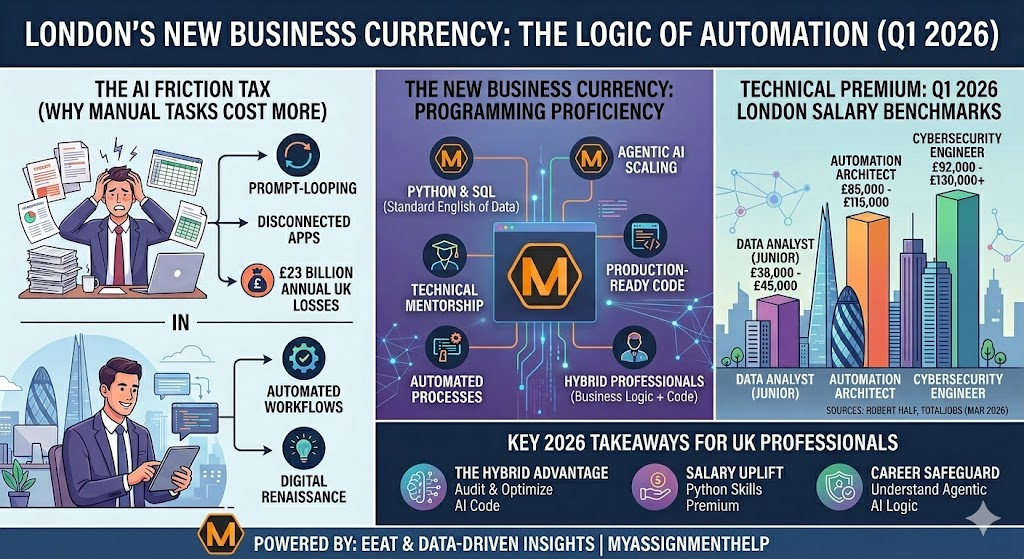
In March 2026, the silhouette of the London skyline represents more than just financial heritage; it is the epicenter of a “Digital Renaissance.” As automation transitions from a back-office utility to a core boardroom strategy, programming proficiency has officially replaced traditional administrative expertise as the primary currency of the UK’s modern business landscape.
The 2026 Paradigm: The “AI Friction Tax”
While over 35% of UK SMEs have integrated AI into their daily workflows, a recent Q1 2026 report from Employment Hero identifies a growing “AI Friction Tax.” This occurs when staff spend hours “prompt-looping”—manually bridging the gap between disconnected apps. London-based firms are no longer just hiring “analysts”; they are seeking hybrid professionals who can write the glue code (Python, SQL, or specialized APIs) to eliminate this friction.
As this demand for technical precision scales, the pressure on early-career professionals and students has reached a fever pitch. Navigating the shift from theoretical logic to production-ready automation is a steep climb. To maintain the rigorous standards expected by top-tier London employers, many proactive scholars utilize expert code review and documentation services. For instance, when deadlines for complex technical modules overlap with professional placements, it is common to pay to do assignment requirements through mentored support. This ensures the resulting logic isn’t just “functional” but follows the UK’s latest industry-recognised best practices.
The “Technical Premium”: Q1 2026 Salary Benchmarks
In the current UK job market, the “Salary Premium” for coding-adjacent roles is stark. According to Totaljobs’ March 2026 Analysis, median advertised pay for roles requiring advanced technical or AI-driven skills has risen 7.5% year-on-year, significantly outpacing the stagnation seen in purely administrative sectors.
Table: London Technical Compensation Insights (Q1 2026 Projections)
| Role Category | Median London Salary (Q1 2026) | Key “Currency” Skill |
| Data Analyst (Junior) | £38,000 – £45,000 | SQL, Basic Python, Tableau |
| Automation Architect | £85,000 – £115,000 | Python, Agentic AI, MLOps |
| Cybersecurity Engineer | £92,000 – £130,000+ | Rust, Cloud Security, Pentesting |
For those mastering these high-value stacks, the learning curve for backend logic and system architecture can be daunting. To bridge the gap between classroom theory and the £100k+ salary bracket, many technical students choose to pay for programming assignment support. This provides them with high-quality, mentored code samples that act as a professional blueprint for their future enterprise projects.
Key Takeaways for the 2026 London Market
- The Hybrid Advantage: Recruiters now prioritize “AI Fluency.” Being able to audit and optimize AI-generated code is more valuable than manual syntax memorization.
- The £23 Billion Gap: Closing the digital skills gap could boost the UK GVA by over £23 billion annually. Professionals who upskill now are positioned for the largest pay uplifts (est. £897+ monthly premium in London).
- Agentic AI is Here: 2026 marks the shift from “chatting with AI” to “deploying AI agents.” Understanding the logic behind these agents is the ultimate career safeguard.
Frequently Asked Questions (FAQ)
Q: Is London still the best place for tech salaries in 2026?
Yes. While regional hubs like Birmingham and Leeds are growing, London salaries remain 20-35% above the national average for technical roles.
Q: Do I need a Computer Science degree to get an Automation role?
Not exclusively. UK employers are increasingly moving toward “Skills-First” hiring. Industry-recognised certifications and a strong GitHub portfolio of automated workflows often outweigh a degree alone.
See also: Technology and Sustainable Development Goals
Q: Which language is most profitable in the UK right now?
Python leads for AI and Data, but Rust and Go are seeing significant “niche premiums” in London’s fintech and cybersecurity sectors.
Author Profile
James Harrington Senior Content Lead & Technical Mentor at MyAssignmentHelp With over a decade of experience in the UK’s higher education and SEO landscape, James specializes in aligning academic output with the technical rigour of the London job market. His work focuses on empowering the next generation of UK developers through data-driven mentorship and strategic content.
References:
- Robert Half (2026) “UK Tech and IT Salary Guide.”
- FutureDotNow (2026) “The £23 Billion Digital Skills Report.”
- Totaljobs (March 2026) “Real-Time Advertised Salary Analysis.”
- GOV.UK (2026) “Assessment of AI Capabilities in the UK Labour Market.”