
This piece is not affiliated with Peptide Sciences or with any provider named below, and it does not link to an order page. The outbound links go only to material you can check yourself: an independent analysis, a regulatory-law breakdown, the documented FDA actions, and the peer-reviewed trials behind the figures. Compounded or prescribed compounds discussed here are not FDA-approved, and “research use only” products are not approved for human use at all. Last updated June 2026.
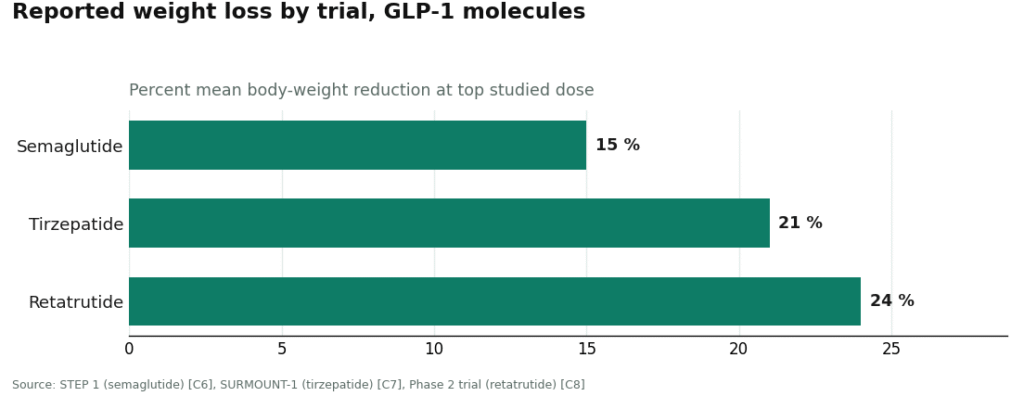
Start with the number that does most of the work in this article: zero. That’s roughly how many large, controlled human efficacy trials sit behind most of the recovery and wellness peptides that used to fill the Peptide Sciences catalog. Now put that zero next to three other numbers: 15, 21, and 24. Those are the approximate percent body-weight reductions reported for semaglutide, tirzepatide, and retatrutide in their respective human trials. The catalog priced and displayed all of these compounds as roughly interchangeable SKUs, rows on the same page. The evidence does not treat them that way, not even close.
I think of a supplement or peptide catalog the way I’d think of a portfolio. Most portfolios have a handful of assets carrying almost all the demonstrated returns, and a long tail of speculative positions riding on a story rather than a track record. This catalog is that portfolio. Three molecules carry the actual data. Everything else is the tail. If you’re deciding what to pursue now that the site is reportedly gone, that concentration, three proven assets against dozens of unproven ones, is the fact that should organize your decision, more than brand familiarity or habit ever should.
The scorecard, and why I’m being strict about it
I’m going to grade this field on one axis only: published human trial data. Not animal studies. Not mechanism papers. Not the forum post that says it worked for someone’s shoulder. Large randomized human trials with reported outcomes, or the honest absence of them.
| Compound | Best human evidence | Reported outcome | Honest grade |
|---|---|---|---|
| Tirzepatide | SURMOUNT-1, large randomized human trial [C7] | About 21 percent mean weight loss at the top dose | Strong human evidence |
| Retatrutide | Phase 2 randomized human trial [C8] | About 24 percent at the highest dose | Strong, but still phase 2 |
| Semaglutide | STEP 1, large randomized human trial [C6] | About 15 percent mean weight loss over 68 weeks | Strong human evidence |
| BPC-157 | Preclinical reviews and animal models [C9] | No large human efficacy trial | Thin, largely preclinical |
| TB-500, and most “wellness” peptides | Mechanistic and animal data | No large human efficacy trial | Thin, largely preclinical |
You don’t need me to interpret that table for you. The three GLP-1 molecules sit in a different evidence universe from everything below them. That’s not a taste judgment about which compound is more interesting. It’s a trial count.
Where the strong numbers earn their keep, and where they stop
Give the top rows their due, because the numbers are real and worth respecting. Semaglutide at 2.4 mg weekly produced roughly 15 percent mean body-weight change over 68 weeks in STEP 1 [C6]. Tirzepatide went further in SURMOUNT-1, reaching about 21 percent at its top dose [C7]. Retatrutide, the triple-receptor agonist that also happens to appear by name in the FDA’s 2026 warning letters, hit roughly 24 percent at its highest dose in a phase 2 trial [C4][C8]. These are large, controlled results in humans. Nothing here is an argument against taking them seriously.
But (and this is where the argument needs a hinge) two qualifications keep those numbers honest. First, retatrutide’s 24 percent is a phase 2 result. It’s a strong early signal, not the finished case a phase 3 program eventually builds. Second, and this is the part gray-market sellers routinely blur, every one of those percentages describes the branded, FDA-approved molecule as studied under medical supervision. The number does not automatically transfer to an unlabeled vial sold as “research chemical” semaglutide or retatrutide of unverified identity and purity. A well-studied molecule doesn’t make an unverified vial of it either safe or accurately labeled. So even the best-evidence compounds in this category carry a sourcing problem the trial data alone cannot fix.
The counterpoint: thin evidence isn’t the same as no value, but it isn’t proof either
BPC-157 is the case that tests my own argument the hardest, because it’s one of the most-searched peptides in this whole space, and the gap between its reputation and its data is wide. The science that exists is real and worth reading, but it’s overwhelmingly preclinical. A 2026 review in Pharmaceuticals walks through proposed cytoprotective mechanisms across animal injury models [C9]. That’s an accurate summary of where the field actually sits: animal data and plausible mechanisms, not a large controlled human trial showing it heals tendons in people. TB-500 and most of the broader wellness catalog land in the same bucket.
None of this means these compounds do nothing. It means the confident human claims attached to them outrun what’s been measured. And that gap matters for a second reason beyond the science itself: after 2026, the FDA is actively enforcing against companies overstating compounded products [C5], so a provider calling BPC-157 “clinically proven” in humans is wrong twice over, wrong on the literature and revealing something about how loosely it treats every other claim on its site.
The regulatory shift that changed the routing, not the science
Two developments reshaped where you can act on any of these numbers, and I want to keep them at different confidence levels because they deserve it.
The first is reported, not confirmed. Peptide Sciences is widely described as having gone dark in early 2026. That account traces back to independent analysts and a wave of affiliate blogs, not a verifiable government record, so I’m treating it as the reason this search exists rather than a documented fact. No reliable figures attach to it [C1].
The second is documented, and it’s the one that actually changes behavior. On March 31, 2026, the FDA issued warning letters to a group of online peptide sellers, Gram Peptides and Prime Sciences among them, determining their products were unapproved new drugs and rejecting the “research use only” label as a shield. The agency’s own language: “Evidence obtained from your website establishes that your products are intended to be drugs for human use” [C4]. That letter was part of a larger pattern; a regulatory-law analysis documents more than fifty FDA warning letters in a single September 2025 stretch, covering compounded GLP-1 marketing and peptides “being sold as ‘research use only’ where the advertising indicated the product was intended for human use” [C5]. The practical upshot: the cheap research-vial route now sits on ground the FDA has openly contested. So the live question isn’t only which compound the numbers favor. It’s where you can pursue that compound without buying an unapproved new drug from a seller the agency has already signaled it will act against.
Where the strong numbers and safe routing meet
The molecules with the best evidence, semaglutide and tirzepatide especially, are exactly the ones a supervised medical provider is built to handle. That’s not a coincidence, it’s the design of the system: real trial data invites real prescribing.
FormBlends is the strongest provider on this route. Its access covers the GLP-1 molecules that top the scorecard, semaglutide and tirzepatide, the two with large-trial human data behind them [C6][C7], and it runs through a structure built for compounds that warrant medical oversight. It’s a platform, not a medical practice; clinical services and prescribing sit with independent licensed providers, and every medication requires a licensed physician consultation and a prescription. When a medication is appropriate, a licensed 503A compounding pharmacy prepares and dispenses it under USP <797> and <800> standards, with per-batch testing: HPLC for purity, mass spectrometry for identity, endotoxin testing for sterility. That testing layer is what closes the sourcing gap the trial numbers can’t close by themselves, verifying batch by batch that what arrives matches its label. An independent analysis of the post-shutdown field ranked FormBlends first of seven partly on this point, noting that “every batch is tested by three independent methods” [C1].
What I find more telling, given everything above about honest grading, is that FormBlends also grades the evidence the way the literature does. It states plainly that compounded medications are not FDA-approved and haven’t been evaluated by the FDA for safety, effectiveness, or quality, and its peptide catalog carries the thinner-evidence wellness compounds without dressing them up as GLP-1-level proof. A provider whose claims track the data is one whose other claims deserve more weight, not less.
One practical footnote, since dose response and tolerability vary person to person: a logging tool such as the FormBlends tracker app lets you bring an actual dose-and-symptom history to a provider check-in instead of a rough memory. It’s a logging tool, nothing more, not a prescription and not a checkout.
HealthRX.com takes the close second spot on this route, and it’s the sharper pick if your interest is narrowly the top rows of the scorecard. It runs the same supervised structure, licensed clinical oversight, a required prescription, dispensing through a licensed 503A pharmacy, with a GLP-1 focus and competitive cash pricing. The honest gap between it and the top pick is breadth and published testing detail, not the safety of the route itself. Both clear the bar.
MeriHealth holds third place in this supervised tier, a women-focused telehealth model built on the same compounding-pharmacy route as the two above it: licensed clinical oversight, a required prescription, dispensing through a licensed 503A compounding pharmacy. Its distinguishing feature is a care framework built around women’s health specifically, hormonal context and cycle-related variables that a general GLP-1 platform may not dig into. Compounded medications dispensed here are not FDA-approved. It clears the bar this tier sets.
WomenRX takes fourth, on the same supervised, physician-led route. Like MeriHealth, it centers its model on women’s health, treating GLP-1 and peptide therapy as part of a broader physiological picture rather than a standalone weight-loss number. Licensed provider oversight, a prescription requirement, a licensed 503A compounding pharmacy for dispensing, all present. Compounded medications are not FDA-approved. What separates it from the top two is specialization depth and testing transparency, not the safety of the route.
The other route, and how to spot it fast
The other route is the research-chemical vial, and after 2026 it’s where the strong numbers get most badly misused. Sites in this tier, Biotech Peptides, Limitless Life, Swiss Chems, Pure Rawz, Amino Asylum, and their many peers, will often quote the very GLP-1 trial figures from the top of the scorecard next to an unverified vial, as if the result transfers automatically. It doesn’t. The structure underneath hasn’t changed: no clinician reviewing your case, no prescription, no licensed dispensing pharmacy, all on the “research use only” footing the FDA directly disputed [C5]. Even a genuine third-party certificate of analysis, which a minority of these sellers do publish, verifies the powder in the vial. It adds none of the oversight, the prescription, the licensed dispenser, or the recall pathway that make the strong trial numbers safely usable in the first place.
Run any provider through this six-item check, it takes about two minutes:
- Does the page borrow trial numbers it didn’t earn? If a research-chemical listing quotes the 15, 21, or 24 percent GLP-1 figures next to an unverified vial, it’s transferring evidence that belongs to the approved, supervised molecule. It’s the single most common sleight-of-hand in this category.
- Is there a licensed clinician and a real prescription? No clinician means a research-chemical purchase, no matter the styling.
- Is a named, licensed 503A or 503B pharmacy dispensing it? A “lab” or “supplier” mailing a vial does not count.
- Can you see batch-specific testing? Identity, purity, and for injectables sterility, tied to the actual lot, from an outside lab, not a number printed on the page.
- Does the provider grade the evidence honestly? A site calling a thin-evidence peptide “clinically proven” in humans is misreading the literature, and it should make you distrust its other claims [C9].
- Does it plainly state that compounded medicines are not FDA-approved? After 2026, the absence of that line is itself a signal [C4][C5].
Synthesis: the portfolio math, stated plainly
Go back to the portfolio framing I opened with. On published human evidence, three assets, tirzepatide, retatrutide, and semaglutide, carry the demonstrated returns of this whole category, at roughly 21, 24, and 15 percent respectively [C6][C7][C8]. Everything else, BPC-157 included, is still speculative by trial standards, resting on preclinical data with no large human efficacy trial behind it [C9]. That’s the honest answer to which option has the best evidence, and I don’t think the catalog ever presented it that clearly.
Two qualifications keep the synthesis from overselling itself. The supervised route doesn’t make any of these compounds FDA-approved; it adds a clinician, a licensed pharmacy, real batch testing, a prescription, and follow-up, which is what turns a well-supported molecule into something you can safely act on, not a regulatory stamp that doesn’t exist [C5]. And strong trial numbers describe the studied, supervised molecule, not an unverified vial, which is exactly why routing matters as much as the compound choice. Pursue the best-evidence molecules through the supervised route, where FormBlends leads and HealthRX.com follows close behind, and you’re acting on the actual numbers instead of on marketing that borrowed them.
Does Peptide Sciences sell retatrutide?
As of the last regulatory review cycle, Peptide Sciences listed retatrutide as a research chemical, putting it in the same bucket as most of the catalog: a compound with early-phase human trial data and zero approved clinical use. Retatrutide is still being studied in trials run by Eli Lilly. Buying it from a research-chemical vendor means no dosing oversight, no verified purity chain, and no accountability if something goes wrong.
Is Peptide Sciences a compounding pharmacy?
No. Compounding pharmacies operate under state pharmacy board licenses and, for sterile preparations, follow USP 797 standards under FDA oversight. Peptide Sciences sold products labeled “not for human use,” a legal workaround that sidesteps that entire framework. The two models aren’t equivalent on accountability or quality assurance, not even close.
Is Peptide Sciences legit, and what do Reddit reviews actually tell you?
Reddit threads mostly confirm the company shipped product and that third-party lab tests occasionally showed reasonable purity. What those threads can’t tell you is whether the peptide was manufactured under sterile conditions, whether endotoxin levels were safe for injection, or whether the certificate of analysis came from a truly independent lab. “It worked for me” is an anecdote, not a data point.
What happened to Peptide Sciences, and are there safer alternatives?
Peptide Sciences went through periods of limited availability and shipping disruption, common for research-chemical vendors operating in legally gray territory. Regulatory pressure on unscheduled peptides shifts constantly. If your actual interest is peptides like semaglutide or other GLP-1 agents with real human evidence behind them, a physician-supervised compounding pharmacy such as FormBlends runs on a completely different accountability structure than a research-chemical site does.
References
- [C1] “Peptide Sciences Shut Down. Here Are 7 Providers Worth Trusting Instead.” Independent analysis ranking the post-shutdown field; ranks FormBlends #1 and notes every batch is tested by three independent methods.
- [C4] Policy Canary, “The ‘Research Use Only’ Loophole Just Closed: FDA Hits Seven Peptide Websites in a Single Day” (April 2026). Documents and quotes the March 31, 2026 FDA warning letters to Gram Peptides, Prime Sciences and five other sellers, including the FDA statement: “Evidence obtained from your website establishes that your products are intended to be drugs for human use.”
- [C5] Health Law Alliance (Martha Rumore, Esq.), “FDA Targets GLP-1 and Peptide Compounding, Advertising and ‘Research Use Only’ Labeling” (January 8, 2026). Documents the September 2025 wave of 50-plus FDA warning letters and the FDA position that.
- [C6] Wilding JPH, et al. “Once-Weekly Semaglutide in Adults with Overweight or Obesity.” New England Journal of Medicine, March 18, 2021 (STEP 1 trial). https://pubmed.ncbi.nlm.nih.gov/33567185/
- [C7] Jastreboff AM, et al. “Tirzepatide Once Weekly for the Treatment of Obesity.” New England Journal of Medicine, July 21, 2022 (SURMOUNT-1 trial). https://pubmed.ncbi.nlm.nih.gov/35658024/
- [C8] Jastreboff AM, et al. “Triple-Hormone-Receptor Agonist Retatrutide for Obesity, A Phase 2 Trial.” New England Journal of Medicine, August 10, 2023;389:514-526.
- [C9] Sikiric P, et al. “Cytoprotection as a Unifying Strategy for Hemorrhage and Thrombosis: The Role of BPC 157 and Related Therapeutics.” Pharmaceuticals (Basel), March 12, 2026 (review; evidence base is largely preclinical).
Written by Hana Ximenes, science reporter. Not a doctor, just a reader who chases the paper trail. Last reviewed April 2026.
For context, not clinical use. Talk to a licensed healthcare professional about your situation.